


The Fouli
The Five Senses Summer Edition 2026
About
27th July, 2026
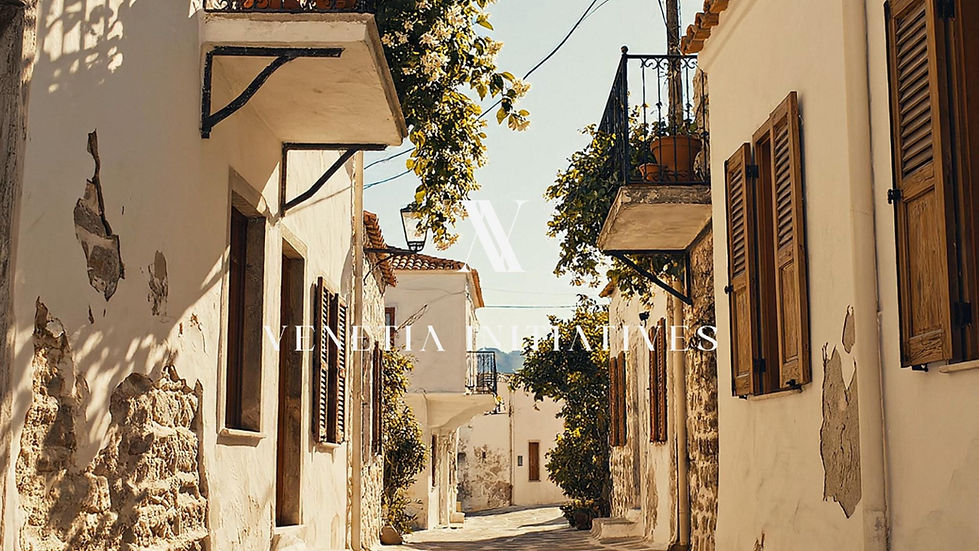
Fouli — Jasminum sambac — is a small white star-shaped flower whose scent sits somewhere between jasmine and gardenia: creamy, nocturnal, more intense than its size would suggest. It has travelled for centuries; from the balconies of Athens into the streets and courtyards of Chefchaouen's medinas. This is not the journey of a flower. It is the journey of a scent. ‘Fouli’ does not announce itself. It settles slowly, into the warm evening air, into skin, into the memory of a summer night long after the sun has gone. Small white blossoms in terracotta pots. The narrow streets of a medina at dusk. Light falling differently as the day softens. The delicate weight of a flower in the hand. Warm air moving through an open street.
Somewhere, jasmine tea is steeping. Its fragrance rises slowly, the bittersweet ritual shared across Athens and Morocco for generations. And then, stillness. A balcony in Athens, a riad in Marrakech, the last light fading, the day releasing itself breath by breath into the night, carrying with it the scent of Fouli. The way memory moves softly, and without return.
CLICK VIDEO TO PLAY
video created by Suki Hussain
Editor's note
This summer's edition carries a quiet debt to Jane Bowles, the American writer, married to Paul Bowles, whose own voice too often stood in his shadow. It was in the mid-1990s that her writing found me, in a hard season of resettling, leaving Berkeley and the Bay Area behind for Athens. Her writing kept me company then, closer than most friends I had. I've carried her with me since, and this summer, back at my desk in New York, I returned to her again: "The Portable" Paul and Jane Bowles, edited by Millicent Dillon, open beside me these past weeks. Her stories, her letters. She and Paul made their home in Tangier, among the medinas of Morocco, the same threshold this “Fouli" edition crosses: from Athens balconies into the streets and courtyards of Chefchaouen, into a riad in Marrakech.
Here in downtown Manhattan, by the water, my life and my desk under one roof, the streets have already emptied, everyone else pulled toward the sea while I stay. My daughter, Nefeli, is uptown this summer, and some evenings we meet, a small joy I wouldn't trade for the coast. And partly, I've stayed because of the news from Greece, arriving in pieces, then in whole: fires tearing through the same hills and balconies where “fouli “ grows, at a scale I have never seen. The sadness comes from there: a flower this Athenian, this small and particular, and the land it comes from going up in smoke. I cancelled the trip: one less flight, one less weight added to an already overheated summer, a small way of asking the earth for some rest.
It was Jane's voice, and a life spent crossing between worlds not her own, that first drew this thread through Fouli. This edition is dedicated to her. Below, a passage from her own writing on the medina.
- Venetia Kapernekas
"The highest street in this blue Arab town skirted the edge of a cliff. [...] You sit in their house and you eat in their house and you sleep in their house. [...] 'Aeshcha!' she hollered, twisting her neck so that her voice could be heard in the patio. 'Bring the tea!' [...] Moroccan etiquette demands that a host make every effort to keep his guest from leaving. [...] The houses on either side of me were so close I could smell the dampness of the walls and feel it on my cheeks like thicker air. [...] No matter how often I walked through these streets reaching out to touch the chalky blue wash on the houses . . . on the walls, I could never satisfy my longing for the town."
— Jane Bowles, East Side: North Africa, Mademoiselle, April 1951. Collected in Jane Bowles: Collected Writings (Library of America, 2016).