Munich | FUTURO ‘Flying Saucer in Town’

Updated: Oct 23, 2025
“Deities, conspiracies, politics, space aliens: you don’t actually have to believe in these to find them interesting ” Perhaps Carl Gustav Jung (psychotherapist and onetime Freud protégé) treated UFOs this way when he wrote his book Flying Saucers: ‘A Modern Myth of Things Seen in the Skies’ which examines “not the reality or unreality” of the titular phenomena, but their “psychic aspect’ …However, Dr Angelika Nollert (director of the Design Museum) and her team anchored FUTURO at the courtyard of Pinakothek der Moderne.
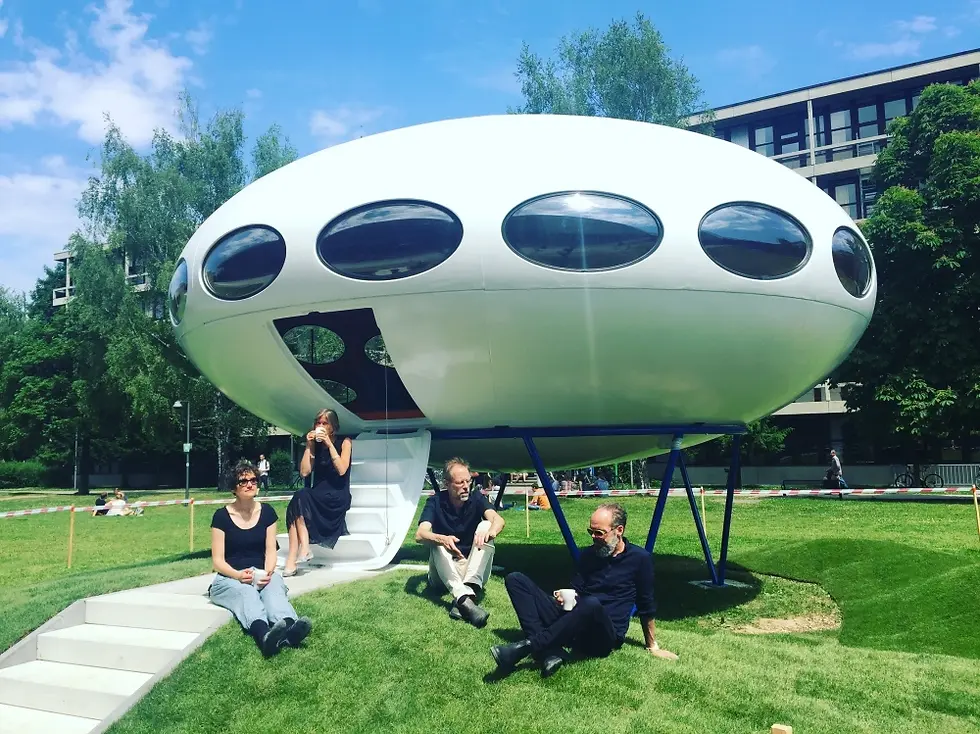
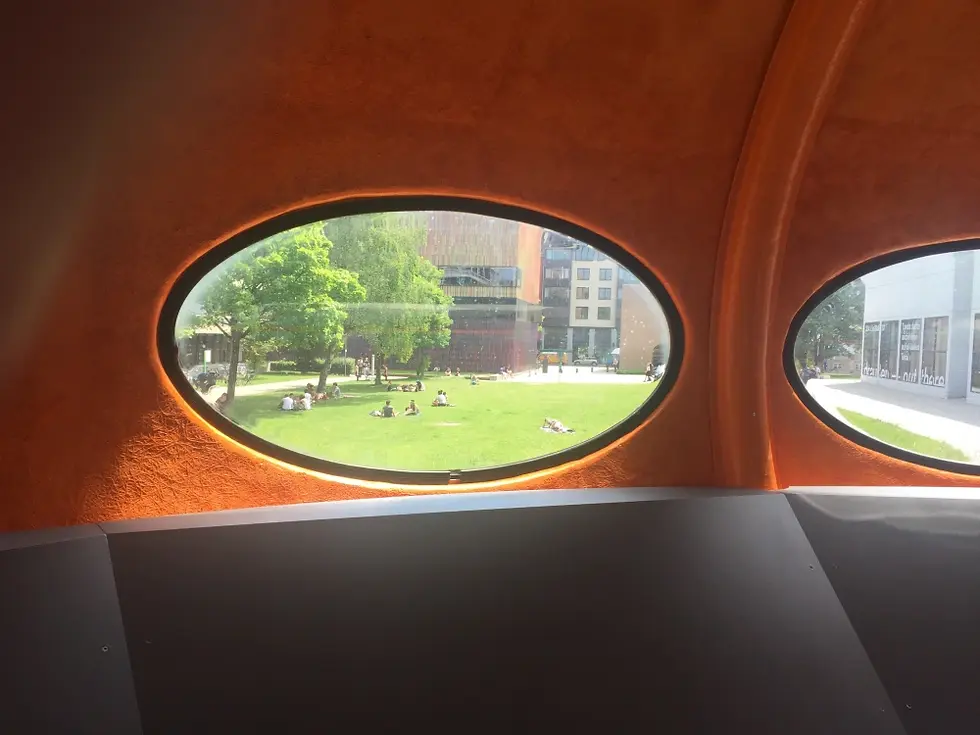
The FUTURO house was acquired in 2016 for Die Neue Sammlung and it is now on show for the first time after comprehensive restoration work. Apart from a continuous bench right round, its circular, open-plan room boasts no interior fittings. The FUTURO house in Munich was initially purchased by Stiebel Eltron in the early 1970s and erected on the company site in Vlotho. It was subsequently acquired by the Charles-Wilp-Museum in Witten in 2012. From there, it has moved to Munich. In the 1970s, artist, graphic designer and composer Wilp owned a FUTURO house which was wrapped by Christo in 1970 and in which artists such as Andy Warhol, Claes Oldenbourg and Yves Klein guested; it has not, unfortunately, survived.Curated by Dipl. Rest. Univ. Tim Bechthold, Dr. Caroline Fuchs and Dr. Angelika Nollert
A flying saucer (also referred to as a flying disc) is a descriptive term for a supposed type of flying craft having a disc or saucer-shaped body, commonly used generically to refer to an anomalous flying object. The term was coined in 1930 but has generally been supplanted since 1952 by the United States Air Force term unidentified flying objects or UFO’s.
….”what it may signify that these phenomena, whether real or imagined, are seen in such numbers just at a time” — the Cold War — “when humankind is menaced as never before in history.” As what Jung called a “modern myth,” UFOs qualify as real indeed. (source: Carl Jung’s fascinating 1957 letter on UFOs at Open Culture)

There are unfortunately no records of how many FUTURO houses were sold in total. At a conservative estimate there were originally around 70 of them, of which around 60 are still in existence today.

FUTURO was manufactured by Finnish company Polykem Ltd. as one of the world’s first mass-produced plastic houses and marketed internationally.

Its walls are made of fiberglass-reinforced polyester shells with a sandwich layer of polyurethane foam providing insulation. In order to make assembly and dismantling easier, the house was manufactured in 16 arc segments which could be assembled on site in the space of only two days. A total of 16 double-glazed windows afford a panoramic view right round.

With a diameter of eight meters and an overall height of just under six meters the building offers around 25 m² of living space which can be heated by electricity in less than 30 minutes. The building rests on a stable tubular steel frame. It has been designed so that it can even be erected on rough terrain and can withstand not only extreme temperatures, but also earthquakes and storms. The door doubles up as fold-out stairs similar to those on small private jets, and these can be used to access FUTURO, which seemingly floats on its steel base.


Around dawn on April 14, 1561, residents of Nuremberg saw what they described as an aerial battle, followed by the appearance of a large black triangular object and then a large crash outside of the city. According to witnesses, there were hundreds of spheres, cylinders and other odd-shaped objects that moved erratically overhead

A manuscript illustration of the 10th-century Japanese narrative, The Tale of the Bamboo Cutter, or The Tale of Princess Kaguya ( details the life of a mysterious girl called Kaguya-hime, who was discovered as a baby inside the stalk of a glowing bamboo plant) depicts a round flying machine similar to a flying saucer.
….That summer, whenever Kaguya-hime saw the full moon, her eyes filled with tears. Though her adoptive parents worried greatly and questioned her, she was unable to tell them what was wrong. Her behaviour became increasingly erratic until she revealed that she was not of this world and must return to her people on the Moon. ……


……As the day of her return approached, the Emperor sent many guards around her house to protect her from the Moon people, but when an embassy of “Heavenly Beings” arrived at the door of Taketori no Okina’s house, the guards were blinded by a strange light. Kaguya-hime announced that, though she loved her many friends on Earth, she must return with the Moon people to her true home. She wrote sad notes of apology to her parents and to the Emperor, then gave her parents her own robe as a memento.
Fata Morgana, a type of mirage, may be responsible for some flying saucers sightings, by displaying objects located below the astronomical horizon hovering in the sky, and magnifying and distorting them.
The first documented patent for a lenticular flying machine was submitted by Romanian inventor Henri Coanda He made a functional small scale model which was flown in 1932 and a patent was granted in 1935 . At a Symposionum organized by the Romanian Academy in 1967 Coanda said:
‘These airplanes we have today are no more than a perfection of a toy made of paper children use to play with. My opinion is we should search for a completely different flying machine, based on other flying principles. I consider the aircraft of the future, that which will take off vertically, fly as usual and land vertically. This flying machine should have no parts in movement. The idea came from the huge power of the cyclons”